

WHEN THE CENTRE CANNOT HOLD
The Changing Architecture of Global Power in the Twenty-First Century

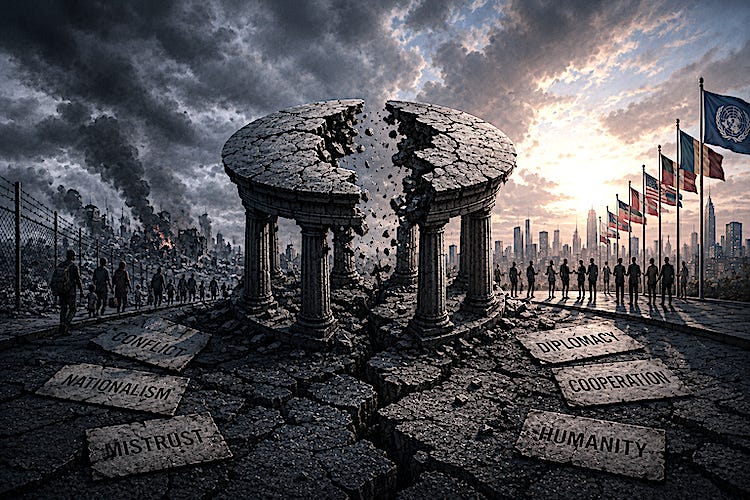
Author’s Note: International affairs are often discussed in terms of individual crises—Ukraine, the Middle East, artificial intelligence, the strategic rivalry between the United States and China, or the future of the United Nations. This essay argues that these developments are better understood not as isolated events but as interconnected expressions of a deeper historical transformation.
Turning and turning in the widening gyre
The falcon cannot hear the falconer;
Things fall apart; the centre cannot hold;
Mere anarchy is loosed upon the world...
— William Butler Yeats, The Second Coming (1919)
International orders seldom collapse in a single dramatic moment. More often, they gradually lose the capacity to govern new forms of power. Their institutions continue to function. Treaties remain in force. Summits are convened, communiqués issued, and diplomatic rituals faithfully observed. Yet beneath this appearance of continuity, the foundations of stability begin to shift. What first appears as a succession of unrelated crises gradually reveals itself as the emergence of a new strategic age.
More than a Century has passed since William Butler Yeats wrote The Second Coming in the shadow of the First World War. Europe lay devastated, ancient empires had disappeared, and the certainties of the nineteenth Century had dissolved. Yeats was not predicting a particular political future. He captured something more enduring: the unease of living through a historical transition in which inherited assumptions could no longer explain an emerging reality. That unease feels strikingly familiar today.
Each morning brings news from another theatre of tension. The war in Ukraine continues in its fourth year. The Middle East remains vulnerable to wider regional confrontation. While Donald Trump’s support for NATO fluctuates, Europe is rebuilding its military capabilities on a scale not seen since the Cold War. Strategic competition between the United States and China now extends far beyond conventional military power to include artificial intelligence, advanced semiconductors, quantum technologies, cyberspace, and outer space. Across Africa, conflict, fragile governance and climate pressures increasingly generate consequences that reverberate far beyond the continent itself.
These developments, viewed individually, belong to different regions’ histories and political contexts. However, together they tell a different story, pointing to a profound shift in global power architecture.
The challenge confronting governments is no longer how to manage individual crises. It is how to govern an international order in which every dimension of power is changing simultaneously.
History suggests these moments are rare indeed.
The Peace of Westphalia established the sovereign state as the organising principle of international relations. The Congress of Vienna sought to preserve stability through a carefully balanced European order.
Following the devastation of the Second World War, the United Nations, the Bretton Woods institutions and an expanding framework of international law helped create an international architecture that, despite repeated crises and shortcomings, prevented direct military confrontation among the major powers for almost eight decades while enabling unprecedented economic integration, scientific cooperation and global development.
Every international order reflects the dominant technologies, economic structures, and power distribution of its time. Even as those foundations have shifted, none have remained static. Today, that framework confronts its most challenging test.
The challenge isn’t stemming from a single nation, ideology or conflict. It’s the confluence of transformative changes redefining power itself. Military capability relies more on technological innovation and industrial resilience. Economic interdependence and strategic rivalry coexist uneasily. Private tech companies now wield significant influence over international security alongside governments. Artificial intelligence compresses decision-making into seconds while diplomacy remains bogged down in consultation, negotiation and compromise.
Technology accelerates history while politics struggles to keep pace. This unprecedented disparity in their speeds could become the defining strategic challenge of our Century.
This essay doesn’t argue for an inevitable Third World War. History doesn’t follow a predetermined script; instead, it suggests humanity has entered a transformative period akin to the significant strategic turning points of 1648, 1815 and 1945.
The focus has shifted from preventing future conflicts to whether institutions built for a different strategic era can adapt before technological acceleration, geopolitical rivalry, and economic fragmentation eclipse political wisdom. Daily headlines reflect this change while the forces reshaping the international order remain largely unchanged.
The Battlefield as Laboratory
Wars have always functioned as laboratories of history. They achieve far more than simply securing territory or establishing political power. They reveal the strengths and weaknesses of societies, accelerate technological progress, and force governments to reconsider long-held assumptions that have shaped national strategy for decades.
The Napoleonic Wars showed the power of mass mobilisation. The American Civil War predicted industrialised warfare. The First World War changed artillery, logistics, and production into military power. The Second World War introduced radar, strategic bombing, ballistic missiles, and nuclear weapons, permanently changing the relationship between military capability and politics.
The war in Ukraine is a pivotal moment in warfare, showcasing the convergence of autonomous systems, AI, and digital intelligence. The rise of inexpensive, AI-enhanced drones has shifted the economics of warfare, making numerical superiority less important than technological innovation and integration.
The war in Ukraine highlights the blurring lines between civilian and military technology, with commercial innovations playing a crucial role in modern warfare. This convergence extends beyond the battlefield, impacting strategic balance and redefining deterrence. Governments are reassessing defence planning, recognising the interconnectedness of technology, industry, economics, and national security.
The Reinvention of Deterrence
Following Russia’s invasion of Ukraine, European governments are re-evaluating their defence strategies, recognising that economic interdependence alone cannot guarantee security. This has led to increased military spending, strengthened NATO presence, and a renewed focus on deterrence, including resilience against cyberattacks and other non-traditional threats. Additionally, the importance of industrial capacity in sustaining military power is being rediscovered, influencing public policy on strategic assets and supply chains.
The post-Cold War order is shifting, with countries such as Japan, Australia, South Korea, and India strengthening their defence capabilities and prioritising military preparedness, technological leadership, and international partnerships. This transformation highlights the interconnectedness of national security, industrial policy, technological innovation, and economic resilience.
Contemporary crises are increasingly interconnected, with developments in one region impacting others. The war in Ukraine, for example, has global repercussions, affecting energy markets, grain exports, and defence planning worldwide. This interconnectedness is evident across various regions, from the Middle East’s impact on global energy markets to Africa’s role in the global struggle against poverty and climate change.
Technology Has Become Strategy
Technology is at the core of this transformation. A technological revolution has accompanied every major shift in the international system. The rise of maritime empires depended on advances in navigation and shipbuilding, while the Industrial Revolution shifted power to societies capable of harnessing steam, steel and mass production. Subsequent developments such as aviation, nuclear energy, electronics, and the digital revolution reshaped the twentieth Century.
The twenty-first Century is experiencing a comparable transformation. What sets this era apart isn’t a single breakthrough but the convergence of multiple technologies that are simultaneously redefining economic competitiveness, military capability, political influence, and national resilience. Artificial intelligence advanced semiconductors quantum computing biotechnology autonomous systems cyber capabilities and commercial space are no longer separate fields of innovation. Together they’re becoming the foundations upon which global power increasingly rests.
Technology has become strategy. This simple observation marks a defining departure from the post-Cold War era. For much of the past three decades, technological innovation has been seen primarily as an engine of economic growth.
Governments encouraged digitalisation, international research partnerships, and increasingly integrated supply chains under the assumption that commercial interdependence would reinforce political stability. However, that assumption is giving way to a different reality.
Artificial intelligence exemplifies this transformation with remarkable clarity. It’s already reshaping medicine, scientific research, education, finance and manufacturing. Simultaneously, it’s revolutionising intelligence analysis, logistics, autonomous systems, cyber defence and military planning. The line between civilian and military applications is blurring. Optimisation algorithms developed for industry are improving battlefield logistics. Machine-learning systems initially designed for commercial use are rapidly gaining strategic importance.
This competition is increasingly resembling the creation of parallel technological ecosystems.
Washington aims to restrict access to frontier technologies deemed crucial for national security. Meanwhile, Beijing is accelerating efforts towards technological self-reliance while bolstering its own research capabilities. Reports suggest Chinese policymakers are considering tighter controls on access to their most advanced artificial intelligence models. This indicates both powers are gradually constructing partially separate technological spheres. Some analysts are even describing this emerging landscape as a “Silicon Curtain” – not a complete technological separation but a strategic fragmentation of the world’s most advanced innovation ecosystems.
These implications extend far beyond the United States and China. Countries across Europe and Asia are increasingly recognising the strategic vulnerability of relying on a single supplier for advanced technologies. Semiconductor production, cloud infrastructure, advanced telecommunications, and critical software are becoming matters of national resilience as much as economic policy.
Commercial space represents another frontier in this transformation. Just a generation ago, space was overwhelmingly the domain of governments. Today, commercial enterprises routinely launch satellites, transport scientific laboratories into orbit, and provide communications for millions of civilians and, increasingly, military organisations. Reusable launch systems and sharply declining launch costs are opening entirely new scientific and industrial activities.
The commercialisation of space extends beyond communications. Biotechnology companies are conducting pharmaceutical research in microgravity, where the absence of gravity facilitates biological and chemical processes difficult to replicate on Earth. Experimental manufacturing in orbit is moving from scientific curiosity to commercial reality. Investors increasingly see space not only as a strategic domain but also as a new industrial frontier capable of generating substantial economic value over the coming decades. This has naturally led to strategic competition in the wake of commercial innovation.
Satellite constellations originally designed for global internet connectivity have become indispensable to modern military operations. Secure communications, precision navigation, and battlefield coordination increasingly rely on privately operated systems. This development has prompted efforts to build counter-space capabilities to disrupt or turn off these networks during conflict.
Recent reporting points to expanding Russian-Chinese cooperation in developing technologies intended to interfere with satellite communications through electronic warfare, cyber techniques and other counter-space capabilities. Whether these efforts ultimately succeed is less important than what they reveal: future strategic competition will increasingly extend beyond land, sea and air into the digital and orbital infrastructures upon which modern societies depend.
The relationship between governments and private enterprise is therefore undergoing a profound transformation. For centuries, states exercised an overwhelming monopoly over strategic technologies. Today, technology companies develop advanced AI models, design semiconductors, launch satellites, manage cloud infrastructure and operate digital platforms that connect billions of people. Their decisions increasingly influence economic resilience, military capability and national security.
Artificial intelligence promises to accelerate scientific discovery and medical research. Biotechnology holds the prospect of treating diseases once considered incurable. Commercial access to space may revolutionise manufacturing, pharmaceuticals and environmental monitoring. The same technologies that strengthen economic prosperity can also improve disaster response, public health, and climate research.
Yet every technological revolution creates new strategic dilemmas. The same artificial intelligence capable of diagnosing disease can improve autonomous weapons. The same satellites supporting humanitarian operations may become military targets. The same biotechnology capable of saving lives raises new questions of biosecurity. Scientific progress and strategic competition are advancing together.
The challenge, therefore, is not innovation itself. It is governance. Power is changing faster than the institutions created to govern it.
International law struggles to keep pace with scientific discovery. Regulatory systems remain largely national while innovation increasingly transcends national boundaries. Democratic governments seek to encourage innovation while protecting individual rights. Authoritarian systems pursue technological leadership through different political models. Multinational corporations operate across jurisdictions whose legal frameworks often diverge sharply.
The decisive advantage in the decades ahead will belong not necessarily to the countries possessing the largest armies—or even the largest economies—but to those capable of integrating scientific innovation, industrial capacity, resilient institutions, trusted alliances and responsible political leadership into a coherent national strategy.
This is the emerging architecture of global power. Its foundations no longer rest solely upon territory, population or military strength. They increasingly rest upon knowledge, innovation, resilience and the capacity to govern technologies whose influence now extends across every dimension of international life. Every technological revolution ultimately raises the same political question: Who governs the new power it creates? That question leads naturally to the next challenge.
Can Institutions Catch Up?
The answer to that question will shape not only international politics but the future of the international order itself. History offers reasons for both caution and confidence.
Every major transformation of the international system has been accompanied by instability before new institutions, new rules and new balances gradually emerged. The seventeenth Century gave birth to the modern state system. The nineteenth Century produced the Concert of Europe. The catastrophe of two world wars ultimately led to the creation of the United Nations, the Bretton Woods institutions and an expanding framework of international law designed to replace confrontation with cooperation and power politics with agreed rules.
Those institutions reflected the strategic realities of their time. They assumed a world of sovereign states, clearly identifiable military alliances and governments that exercised an overwhelming monopoly over the principal instruments of national power. They could not anticipate artificial intelligence, cyber warfare, quantum computing, commercial satellite constellations, biotechnology or multinational technology companies whose capabilities would one day rival those of many governments.
The international system has changed far more rapidly than the institutions created to govern it. No organisation illustrates this dilemma more clearly than the United Nations.
For more than eight decades, the United Nations has remained the indispensable framework within which diplomacy could continue even when political agreement proved impossible. It has coordinated humanitarian relief, protected refugees, advanced public health, supported peacekeeping operations, established international legal norms and promoted sustainable development across every continent. Its specialised agencies perform functions without which the international system would become markedly less stable.
Its greatest achievements are often overlooked precisely because they have become part of the normal functioning of international life. Yet the United Nations increasingly confronts challenges that transcend the institutional architecture inherited from the Second World War.
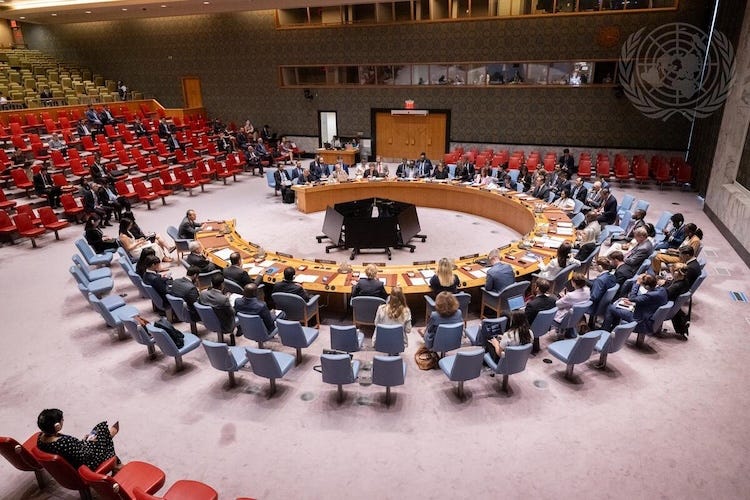
The Security Council still reflects the geopolitical distribution of power that emerged in 1945 rather than the strategic realities of the twenty-first Century. Today’s defining challenges increasingly involve domains that scarcely existed when the UN Charter was drafted: cyberspace, artificial intelligence, outer space, digital infrastructure and privately owned technologies that underpin both civilian life and military operations.
The result is not institutional failure. It is institutional mismatch. The architecture of governance has not evolved at the same pace as the architecture of power. Nor is this challenge confined to the United Nations.
International law struggles to establish norms for autonomous weapons while the technology itself continues to evolve. Diplomatic negotiations often require years while scientific innovation advances within months. National regulatory systems remain bounded by borders even as algorithms, capital, data and digital communications circulate across them almost instantaneously.
History has rarely moved at so many different speeds at the same time. Scientific discovery accelerates. Commercial innovation follows with remarkable speed. Military organisations adapt with increasing urgency. Political institutions change most slowly of all.
Never before have these different clocks moved so unequally. That widening gap has become one of the defining characteristics of our age. Yet history teaches another lesson.
Periods of profound disruption have repeatedly produced remarkable institutional innovation once political leaders recognised that inherited assumptions could no longer explain emerging realities. The shortcomings of the League of Nations informed the design of the United Nations. The devastation of Europe ultimately produced the European Union, one of history’s most ambitious attempts to replace geopolitical rivalry with political and economic integration. Even during the Cold War, adversaries negotiated arms-control agreements, confidence-building measures and crisis-management mechanisms because they understood that rivalry without rules would eventually become uncontrollable.
The present generation confronts a similar responsibility. The challenge is not to preserve existing institutions unchanged. Nor is it to abandon multilateral cooperation in favour of an increasingly fragmented international system. The challenge is adaptation.
The architecture of cooperation must evolve as rapidly as the architecture of power. That adaptation will require more than larger defence budgets or more sophisticated technologies. It will require renewed confidence in diplomacy—not as an alternative to national security, but as one of its essential instruments.
It will require stronger international institutions capable of addressing problems that no nation can solve alone. It will require democracies capable of reconciling innovation with accountability, security with liberty and technological leadership with ethical responsibility.
It will require closer cooperation among established powers, emerging powers and the increasingly influential middle powers whose capacity to build bridges may prove as important as the ability of larger states to project power. Above all, it will require a broader understanding of responsibility.
Power no longer resides exclusively in ministries, parliaments or military headquarters. It increasingly flows through research laboratories, semiconductor fabrication plants, satellite constellations, data centres, financial institutions and technology companies whose decisions shape the security and prosperity of entire nations. The governance of power has therefore become a shared responsibility.
The defining strategic question of our Century is no longer simply who possesses power. It is who can govern power responsibly. For if power is being transformed before our eyes, the ultimate test of our generation will not be whether we can innovate faster than our predecessors. It will be a question of whether we can govern more wisely than they did.
Can the Centre Hold?
More than a Century ago, William Butler Yeats concluded the opening stanza of The Second Coming with words that have echoed through every age of upheaval since:
The blood-dimmed tide is loosed, and everywhere
The ceremony of innocence is drowned;
The best lack all conviction, while the worst
Are full of passionate intensity.
Yeats wrote as Europe emerged from one of history’s greatest catastrophes. He could not foresee the world that would follow, yet he understood something enduring about moments of profound transition. When established structures lose their capacity to contain new forces, uncertainty becomes the defining condition of politics.
Our own age confronts a comparable test. The transformation of global power is no longer a distant prospect. It is unfolding before our eyes. Military competition has expanded into cyberspace and outer space. Artificial intelligence is reshaping economies as rapidly as it is reshaping defence planning. Supply chains have become instruments of strategy. Commercial innovation increasingly influences national security. Middle powers are assuming greater responsibility for regional stability even as the world’s largest powers compete for technological and geopolitical advantage.
None of these developments exists in isolation. Together they constitute a new architecture of power. None of these developments exists in isolation. Together they constitute a new architecture of power.
History suggests that such periods are never comfortable. They compel societies to abandon assumptions that once appeared self-evident and force institutions to adapt to realities they were never designed to confront. Yet history also reminds us that moments of profound disruption have often become moments of remarkable institutional innovation. The Peace of Westphalia, the Congress of Vienna, the United Nations and the European Union all emerged when existing structures proved inadequate to new circumstances.
The question before our generation is therefore not whether change can be prevented. It cannot. Nor is the central question whether technology will continue to advance. It will.
The defining question of our Century is whether political wisdom, democratic leadership and international cooperation can evolve rapidly enough to govern the unprecedented forms of power that science and technology are placing in human hands.
That responsibility belongs not only to governments. It belongs equally to scientists, entrepreneurs, educators, business leaders, international institutions and civil society. Strategic responsibility can no longer be confined to ministries of defence or foreign affairs. In an interconnected world, the governance of power has become a shared enterprise.
The future international order will not be determined solely by the military balance among great powers. The resilience of democratic institutions will also shape it, the responsibility of technology companies, the capacity of international organisations to reform themselves, and the willingness of nations to cooperate even as they compete.
Every generation inherits an international order it did not create. Few are called upon to redesign one. Our generation is among them. The architecture of global power is changing before our eyes. The architecture of global cooperation must evolve with equal determination.
Power alone has never guaranteed stability. Throughout history, stability has depended on societies placing power within institutions capable of restraining, legitimising, and directing it towards the common good. The challenge before humanity is therefore no longer merely to manage the architecture of power. It is to ensure that the architectures of governance and responsibility evolve with equal determination.
Whether the centre holds will depend not upon the sophistication of our weapons, the speed of our algorithms or the scale of our economies alone. It will depend on our capacity to ensure that wisdom evolves as rapidly as power does.
About the author: Ramesh Jaura is affiliated with ACUNS, the Academic Council of the United Nations, and an accomplished journalist with sixty years of professional experience as a freelancer, head of Inter Press Service, and founder-editor of IDN-InDepthNews. His expertise is grounded in extensive field reporting and comprehensive coverage of international conferences and events. Subscribe for free or pay and stay updated. Buy SKYWARD HAVEN – A Speculative Novel. Visit: https://www.rameshjaura.com