

Africa’s Security at a Crossroads
A Continent Confronts a Changing World

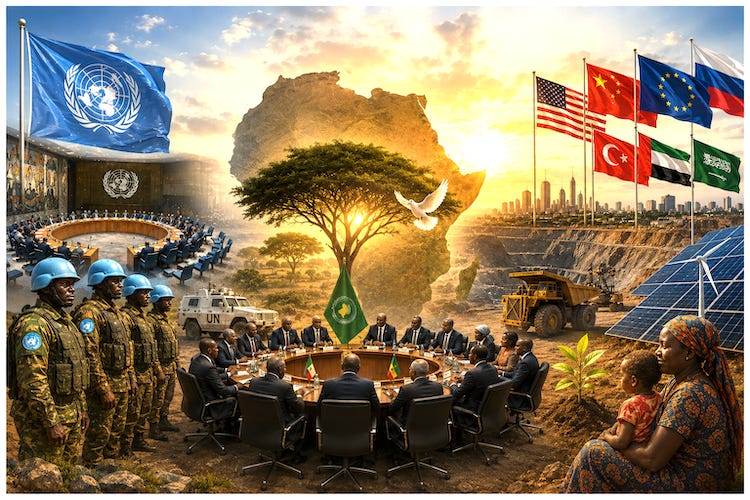
There was a time when Africa was often portrayed as standing at the margins of international politics—its conflicts treated as regional crises, its development challenges largely divorced from the wider currents shaping the global order. That perception no longer holds.
Today, almost every major geopolitical fault line has an African dimension. The war in Ukraine has disrupted food supplies across the continent. The conflict in the Middle East has fuelled energy price volatility and redirected diplomatic attention away from Africa’s own crises. Competition among the United States, China and Russia has expanded into African capitals, while new players—from the Gulf states to Türkiye—are steadily enlarging their political, economic and military footprints.
At the same time, Africa itself has become indispensable to the world economy. Its critical minerals are essential for the global transition to renewable energy and digital technologies. Its rapidly growing population will shape future labour markets and consumer demand. Its strategic waterways remain vital to international trade. Far from being peripheral, Africa now occupies a central place in the emerging geopolitical landscape.
Yet this growing strategic importance coincides with a period of exceptional uncertainty.
The international institutions created after the Second World War are struggling to cope with multiplying crises. Great-power rivalry has returned with unexpected intensity. Development assistance is becoming more selective, sovereign debt continues to constrain economic growth, and climate change is accelerating competition over land, water and livelihoods. At precisely the moment when Africa requires stronger international cooperation, the multilateral system itself is showing unmistakable signs of strain.
Against this backdrop, policymakers, diplomats, military practitioners and scholars gathered at the University of Pretoria in South Africa in May 2026 to examine one of the defining questions of our time: how can Africa strengthen its own security in an increasingly fragmented world?
The discussions, summarised in the policy brief Africa’s Security Challenges in a Turbulent World, reached a sobering conclusion. The international environment that shaped Africa’s peace and security efforts during the three decades following the Cold War is rapidly disappearing. The rules-based order is under growing pressure; the United Nations Security Council finds itself paralysed by geopolitical rivalries; and African conflicts are becoming more interconnected, more internationalised, and increasingly difficult to resolve. Yet the dialogue also offered a measure of optimism. It argued that Africa possesses the institutional foundations, political experience and diplomatic maturity to assume far greater responsibility for managing its own security, provided its regional organisations are given the political backing, financial resources and operational capacity they require.
The central question, therefore, is no longer whether Africa should take greater ownership of its peace and security. That debate was settled long ago. The real challenge is whether African institutions can evolve quickly enough to keep pace with a world in which the geopolitical landscape is changing faster than at any time since the end of the Cold War.
Pax Africana Faces a New Reality
More than half a Century ago, the Kenyan scholar Ali Mazrui coined the expression Pax Africana to describe an ambitious vision: that Africa’s peace should ultimately be secured by Africans themselves rather than guaranteed by external powers.
It was both a political aspiration and a declaration of confidence.
Mazrui argued that lasting peace could not be imposed. It had to grow from African institutions, African diplomacy and African political leadership. Decades later, that vision remains as compelling as ever. Yet it has become immeasurably more difficult to achieve.
Today’s security landscape bears little resemblance to the one that existed when the African Union replaced the Organisation of African Unity in 2002. The continent now confronts an extraordinary convergence of traditional conflicts and emerging threats.
Military coups have returned to parts of West Africa, reversing years of democratic progress. Violent extremist organisations continue to exploit fragile governance across the Sahel, the Lake Chad Basin, Somalia and northern Mozambique. Sudan has descended into one of the world’s gravest humanitarian catastrophes, displacing millions of people and destabilising an already volatile region. In the eastern Democratic Republic of Congo, cycles of violence continue to draw in neighbouring states, armed militias and competing economic interests centred on some of the world’s most valuable critical minerals.
These crises are no longer isolated emergencies.
They increasingly overlap, reinforcing one another through illicit arms trafficking, organised crime, forced migration, food insecurity and environmental stress. Internal fragility is compounded by external competition as major powers pursue strategic influence across the continent through military cooperation, investment, diplomatic engagement and resource partnerships.
The result is a security environment that is far more complex than the one African policymakers confronted even a decade ago.
The Pretoria dialogue captured this changing reality with unusual clarity. Participants observed that conflicts far beyond Africa’s borders are now profoundly shaping the continent’s security prospects. The wars in Ukraine and the Middle East have not only disrupted grain supplies and energy markets but have also diverted international attention, financial resources and diplomatic energy away from African peace initiatives. Meanwhile, the gradual erosion of the post-Cold War international order has encouraged a more transactional style of international engagement, in which long-term partnerships increasingly give way to short-term strategic calculations.
Africa, therefore, finds itself navigating an international system that is becoming less predictable and considerably more competitive.
Instead of viewing the continent primarily as a development partner, many external powers now approach Africa through the prism of strategic rivalry. Critical minerals, maritime routes, migration management, counter-terrorism cooperation, and military access have assumed increasing importance in shaping international relations.
This shift presents African governments with both opportunities and risks.
The wider range of external partners gives them greater diplomatic flexibility than at any point since the Cold War. At the same time, it demands a higher level of political coordination if Africa is to avoid becoming merely another arena in which global powers compete for influence.
That challenge lies at the heart of today’s debate about African security. The question is no longer how to manage conflicts. It is how to preserve African agency in an increasingly turbulent world.
When Global Governance Falters
If Africa’s security challenges have grown more complex, so too has the international system meant to address them.
For much of the post-Cold War era, the United Nations served as the ultimate framework for managing African conflicts. From Namibia and Mozambique to Liberia, Sierra Leone, and Côte d’Ivoire, UN peacekeeping became an indispensable instrument for stabilising societies emerging from war. However imperfect these missions were, they reflected a broad international consensus that peacekeeping was a shared global responsibility.
That consensus has steadily eroded.
Today, the United Nations Security Council finds itself increasingly immobilised by the geopolitical rivalries of its five permanent members. Disagreements over Ukraine, Gaza and wider strategic competition have spilt into discussions on Africa, making consensus on conflict resolution progressively more elusive. Diplomatic deadlock has become almost routine, with humanitarian considerations frequently overshadowed by competing national interests.
The consequences are felt most acutely in Africa.
Conflicts in Sudan, the eastern Democratic Republic of Congo and the Sahel demand coordinated international responses, yet the institutions designed to provide such leadership are struggling to act decisively. The Pretoria dialogue concluded that the Security Council’s paralysis has become one of the principal obstacles to effective conflict management on the continent.
Ironically, African voices within the Council have become more important precisely as the institution itself has become less effective.
The three African non-permanent members—the so-called A3—have increasingly sought to coordinate positions on African crises, bringing valuable regional knowledge and practical peacebuilding experience into Council deliberations. Yet influence ultimately depends on more than moral authority. Limited diplomatic resources, differing national priorities and the absence of a permanent African seat continue to constrain the continent’s ability to shape outcomes on issues that directly affect its own future.
This imbalance has strengthened long-standing African calls for reform of the Security Council.
For decades, African leaders have argued that a continent of nearly 1.5 billion people cannot remain permanently excluded from the Council’s most powerful decision-making circle. Yet despite repeated declarations in support of reform, meaningful change has remained frustratingly out of reach. The gap between Africa’s growing global importance and its limited influence within global governance institutions has become increasingly difficult to justify.
The Future of Peacekeeping Is Being Rewritten
The challenges facing the United Nations extend well beyond diplomacy.
Peacekeeping itself is undergoing a profound transformation.
For more than three decades, large multidimensional missions formed the backbone of the international community’s response to armed conflict. Tens of thousands of blue helmets deployed across Africa helped supervise ceasefires, protect civilians, organise elections and support fragile governments emerging from civil war.
That model is now under unprecedented pressure.
Financial constraints have forced the United Nations to reduce its peacekeeping budget substantially while scaling back personnel in several operations. At the same time, host governments have become less willing to accept large international missions, particularly when they perceive them as ineffective or politically intrusive. The withdrawals from Mali and Burundi reflected not only changing domestic politics but also growing frustration with traditional peacekeeping itself.
As one era of peacekeeping draws to a close, another is only beginning to take shape.
Rather than deploying large international forces, the United Nations increasingly favours lighter missions that support regional organisations capable of taking the lead. This shift recognises an important political reality: African crises are often managed most effectively when African institutions are at the forefront, backed by international financing, logistics and technical expertise.
The concept is attractive. But the practical difficulties are formidable.
The African Union has repeatedly demonstrated its willingness to shoulder greater responsibility, whether in Somalia, the Sahel or elsewhere. Yet willingness alone cannot sustain complex military operations that require strategic airlift, intelligence capabilities, medical support, sophisticated communications and long-term financing.
Without these capabilities, even the most determined peace operation risks becoming unsustainable. That explains why so much attention has focused on United Nations Security Council Resolution 2719.
Adopted in 2023, the resolution was widely hailed as a breakthrough because it opened the possibility of financing African Union-led peace support operations through assessed UN contributions. If fully implemented, it could fundamentally reshape the relationship between the United Nations and the African Union by providing more predictable financial support for African-led missions.
So far, however, that promise remains largely unrealised.
Political disagreements among Security Council members, differing interpretations of oversight mechanisms and unresolved questions about host-country consent have delayed implementation. Potential pilot operations in Somalia, Sudan and northern Mozambique remain uncertain, leaving African peace operations dependent upon ad hoc funding arrangements that rarely provide the continuity required for long-term success.
The implications extend far beyond budgeting.
Reliable financing is ultimately a question of political credibility. If African organisations are expected to assume greater responsibility for maintaining peace, they require predictable resources rather than periodic emergency appeals. Sustainable peacekeeping cannot be built upon uncertain financial foundations.
Building African Capacity, Not African Dependence
The growing emphasis on African-led security should not be mistaken for a retreat from international cooperation—quite the opposite.
The Pretoria discussions repeatedly underscored that collaboration between the United Nations, the African Union and regional organisations remains indispensable. No single institution possesses all the political legitimacy, operational capability and financial resources needed to address today’s increasingly complex conflicts.
The challenge is therefore not to replace one actor with another. It is to create a more balanced partnership in which Africa exercises greater strategic leadership while external partners provide support that strengthens, rather than substitutes for, African institutions.
That distinction is crucial. For too long, international assistance has often focused on responding to crises after violence has erupted. The next phase of African security must place equal emphasis on prevention: strengthening governance, improving early-warning mechanisms, investing in mediation and enabling regional organisations to intervene before local tensions escalate into prolonged wars.
That, ultimately, is the deeper meaning of Pax Africana in the twenty-first Century. It is not a call for Africa to stand alone. It is a call for Africa to lead.
A New Scramble—or a New Opportunity?
Africa has always attracted outside powers. During the colonial era, the continent was carved up in pursuit of territory and resources. Throughout the Cold War, it became an arena where East and West competed for ideological influence. Today, another contest is unfolding, but this time the players are more numerous, the interests more diverse, and the rules far less clear.
Unlike previous eras, today’s geopolitical competition cannot be reduced to a simple East-West divide.
The United States remains deeply engaged through diplomacy, counter-terrorism cooperation and private investment. China has become Africa’s largest trading partner and a major financier of infrastructure projects. Russia has expanded security partnerships and arms exports while strengthening political ties with several governments. Türkiye has emerged as an increasingly important supplier of defence equipment and development assistance. Meanwhile, the Gulf states—notably the United Arab Emirates, Saudi Arabia and Qatar—have significantly increased investments in ports, agriculture, energy and logistics while assuming more active diplomatic roles across the Horn of Africa and the Sahel.
Each of these relationships offers potential benefits. Each also carries strategic risks.
Unlike during the Cold War, African governments now have considerably greater room to diversify their international partnerships. Rather than relying overwhelmingly on a single bloc, many countries have pursued what might be described as strategic multi-alignment—working simultaneously with different partners in line with their national interests.
This growing diplomatic flexibility represents one of Africa’s greatest strategic assets. Yet flexibility is not the same as strategic autonomy.
As competition among external powers intensifies, African governments will increasingly face pressure to take sides on issues extending far beyond the continent itself. Trade, technology, critical minerals, telecommunications, maritime security and even voting patterns in international organisations are becoming part of a wider geopolitical contest.
The challenge for Africa is therefore not to choose between Washington and Beijing, Moscow and Brussels, or Ankara and Abu Dhabi. It is to ensure that these relationships advance African priorities rather than external agendas. That requires stronger continental coordination than currently exists.
The African Continental Free Trade Area has already demonstrated that collective action can strengthen Africa’s negotiating position in the global economy. A similar degree of political coordination will increasingly be required in matters of peace and security if the continent is to preserve its strategic independence.
History offers an important lesson. External powers inevitably pursue their own national interests. There is nothing unusual about that. The responsibility for safeguarding Africa’s interests rests, ultimately, with African governments themselves.
South Africa’s Leadership Tested
No country better illustrates both the promise and the limitations of African leadership than South Africa.
Since the end of apartheid in 1994, Pretoria has sought to position itself as one of the continent’s principal champions of diplomacy, mediation and peacekeeping. South African soldiers have served under both African Union and United Nations mandates in Burundi, Sudan, the Democratic Republic of Congo and Mozambique. South African diplomats have mediated conflicts, facilitated peace agreements and consistently argued that Africa should assume greater ownership of its own security.
For many years, Pretoria embodied the ideals of Pax Africana. Today, however, those ambitions are confronting harsh realities.
The University of Pretoria dialogue paints a sobering picture of a military under increasing strain. Defence spending has failed to keep pace with expanding responsibilities. Much of the available budget is consumed by personnel costs, leaving inadequate resources for equipment modernisation, maintenance and operational readiness. Significant parts of the South African Air Force and Navy are reportedly no longer fully operational, limiting the country’s ability to project influence across a continent where distance itself presents formidable logistical challenges.
At the same time, the South African National Defence Force has been asked to undertake an expanding range of domestic tasks.
From supporting police operations against organised crime and illegal mining to protecting strategic infrastructure, the military has increasingly found itself addressing internal security challenges that were never intended to become permanent military responsibilities. The consequences have become visible beyond South Africa’s borders.
Following casualties suffered in the eastern Democratic Republic of Congo, Pretoria announced the withdrawal of its forces from the Southern African Development Community mission. Earlier, South African troops had also left northern Mozambique after helping stabilise areas threatened by Islamist insurgents. These decisions reflected not a retreat from Africa but the difficult arithmetic of finite resources confronting expanding commitments.
Yet South Africa’s predicament extends beyond military capability. As Africa’s most industrialised economy and one of its most influential diplomatic voices, Pretoria occupies a unique position within continental politics. When South Africa scales back its regional engagement, the effects are felt far beyond its own borders. Questions inevitably arise about who will provide political leadership during future crises, particularly when other traditional regional powers are themselves confronting significant domestic challenges.
Nigeria faces persistent insecurity and economic pressures. Ethiopia continues to recover from internal conflict while navigating tensions in the Horn of Africa. Egypt’s strategic attention remains focused largely on the Middle East and the Nile Basin. The result is a leadership landscape that has become increasingly fragmented.
Africa possesses capable regional organisations, experienced diplomats and growing institutional maturity. What it lacks is a sufficient number of politically and economically strong regional powers capable of sustaining the long-term commitments that continental peace operations demand.
This reality reinforces one of the central conclusions emerging from the Pretoria dialogue. Peacekeeping cannot succeed without capable states willing and able to support capable institutions.
Strengthening the African Union, therefore, also requires strengthening the countries expected to carry much of the operational burden. Regional leadership cannot be improvised during crises. It must be built patiently through sustained investment in institutions, professional armed forces, sound governance and economic resilience.
Only then will Africa possess not merely the aspiration of Pax Africana, but the practical means to achieve it.
Peace Is Built Long Before the Guns Fall Silent
When conflicts dominate the headlines, security is often measured in military terms: the number of troops deployed, weapons supplied, or ceasefires negotiated. Yet Africa’s own experience tells a different story. Peace is rarely secured on the battlefield alone.
Again and again, African societies emerging from conflict have discovered that ending violence is only the first step. The more difficult task is rebuilding trust, restoring institutions and persuading communities that their future will be better than their past. Without that foundation, even the most successful military operation risks becoming little more than a pause between successive rounds of violence.
This understanding lay at the heart of the Pretoria discussions. Participants argued that peacebuilding must move beyond the traditional emphasis on military stabilisation and humanitarian relief. Lasting peace requires functioning institutions, accountable governance, economic opportunity and social inclusion. It also demands justice—but justice that is adapted to local realities rather than imposed through universal templates.
Africa has accumulated considerable experience in this field. South Africa’s Truth and Reconciliation Commission demonstrated that societies emerging from profound political divisions sometimes require imperfect compromises to prevent renewed bloodshed. Liberia’s gradual approach to transitional justice helped consolidate stability after years of civil war. In Sierra Leone and Northern Uganda, community-based reconciliation often proved as important as formal legal processes in helping fractured societies begin to heal.
These experiences point towards an important lesson. Justice and peace are not opposing objectives.
They are complementary processes that must be carefully balanced according to political realities, cultural traditions and the needs of affected communities.
The African Union recognised this when it adopted its Transitional Justice Policy in 2019. Rather than concentrating exclusively on criminal accountability, the policy embraces a broader vision that includes reconciliation, reparations, institutional reform, socio-economic transformation and traditional community mechanisms. It acknowledges that sustainable peace depends not only upon punishing perpetrators but also upon repairing societies.
Perhaps nowhere is this more evident than in the challenge of reintegrating children recruited into armed conflicts.
For many, the end of fighting marks not the end of trauma but the beginning of an uncertain struggle to rebuild their lives. Psychological scars, social stigma and fractured family relationships often persist long after international attention has shifted elsewhere. Successful reintegration, therefore, requires patience, local leadership, and long-term investment—qualities that short funding cycles rarely encourage.
The same principle applies more broadly across the continent. Conflicts do not emerge from a vacuum.
They are nourished by poverty, inequality, weak governance, corruption, political exclusion, environmental degradation and growing competition over increasingly scarce natural resources. Climate change is magnifying many of these pressures, intensifying disputes over land, water and livelihoods while accelerating displacement across already fragile regions.
Military operations may contain these crises. Only good governance can resolve them.
Investing in Peace Before Paying for War
If one issue repeatedly surfaced during the Pretoria dialogue, it was financing. Ambitious strategies, however carefully designed, cannot succeed without predictable resources.
The African Union has made encouraging progress through its Peace Fund, demonstrating a growing determination to reduce dependence on external donors. Yet the scale of Africa’s security challenges still far exceeds the resources currently available. Modern peace operations require transport aircraft, intelligence capabilities, communications systems, medical services, logistics networks and highly trained personnel. Above all, they require continuity.
Peace cannot be financed one emergency appeal at a time. For this reason, the dialogue called for a more predictable partnership among the African Union, the United Nations and the European Union, together with stronger support for the African Standby Force, clearer operational mandates and greater investment in preventing conflicts before they escalate. These recommendations deserve serious international attention because they recognise a fundamental truth: investing in prevention is invariably less costly than rebuilding societies devastated by war.
This is not simply an African concern. The consequences of instability no longer stop at national or even continental borders.
Migration, terrorism, organised crime, disruptions to global supply chains, food insecurity and humanitarian emergencies increasingly affect societies thousands of kilometres away. In an interconnected world, peace in Africa has become an integral component of global security.
The old distinction between regional crises and international crises is rapidly disappearing.
Africa’s Moment of Choice
Africa enters the second half of this decade with unprecedented opportunities and responsibilities. Its economies possess many of the minerals essential for the world’s green and digital transitions. Its youthful population could become one of the twenty-first Century’s greatest economic assets. The African Continental Free Trade Area offers the prospect of creating the world’s largest common market by number of participating countries. Across the continent, innovation, entrepreneurship and regional cooperation are gathering momentum despite formidable challenges.
At the same time, Africa finds itself navigating an international order that is becoming less stable, less predictable and increasingly shaped by strategic competition rather than collective action.
That changing landscape makes one conclusion unavoidable. The future of African security will depend less on the decisions taken in Washington, Moscow, Beijing or Brussels than on those taken in Addis Ababa, Abuja, Pretoria, Nairobi, Accra and other African capitals.
External partnerships will remain indispensable. But partnerships can only complement—not substitute for—strong African institutions. The vision of Pax Africana, therefore, deserves renewed attention.
Ali Mazrui never imagined a continent isolated from the rest of the world. His vision was of an Africa confident enough to shape its own destiny while engaging the international community as an equal rather than as a dependent. Half a Century later, that vision remains unfinished. Yet it has also become more urgent than ever.
The choice before Africa is no longer simply whether to respond to today’s crises. It is a question of building the institutions capable of preventing tomorrow’s conflicts. That is the true measure of security.
In an age of growing geopolitical turbulence, the continent has an opportunity not merely to adapt to a changing world, but to help shape it. Whether Africa becomes the principal arena of twenty-first-century power politics—or one of its most influential architects—will depend largely on the decisions Africans make today. The stakes could scarcely be higher.
About the author: Ramesh Jaura is affiliated with ACUNS, the Academic Council of the United Nations, and an accomplished journalist with sixty years of professional experience as a freelancer, head of Inter Press Service, and founder-editor of IDN-InDepthNews. His expertise is grounded in extensive field reporting and comprehensive coverage of international conferences and events. Subscribe for free or pay and stay updated. Buy SKYWARD HAVEN – A Speculative Novel.